
Thursday, May 24, 2012
May 2012: Waiting for Buds to Push
About one week after the grafting, our new Pinot noir buds are swelling. We await shoot growth in the next few weeks. The young vines are protected by milk cartons.


Monday, May 14, 2012
May 2012 Grafting
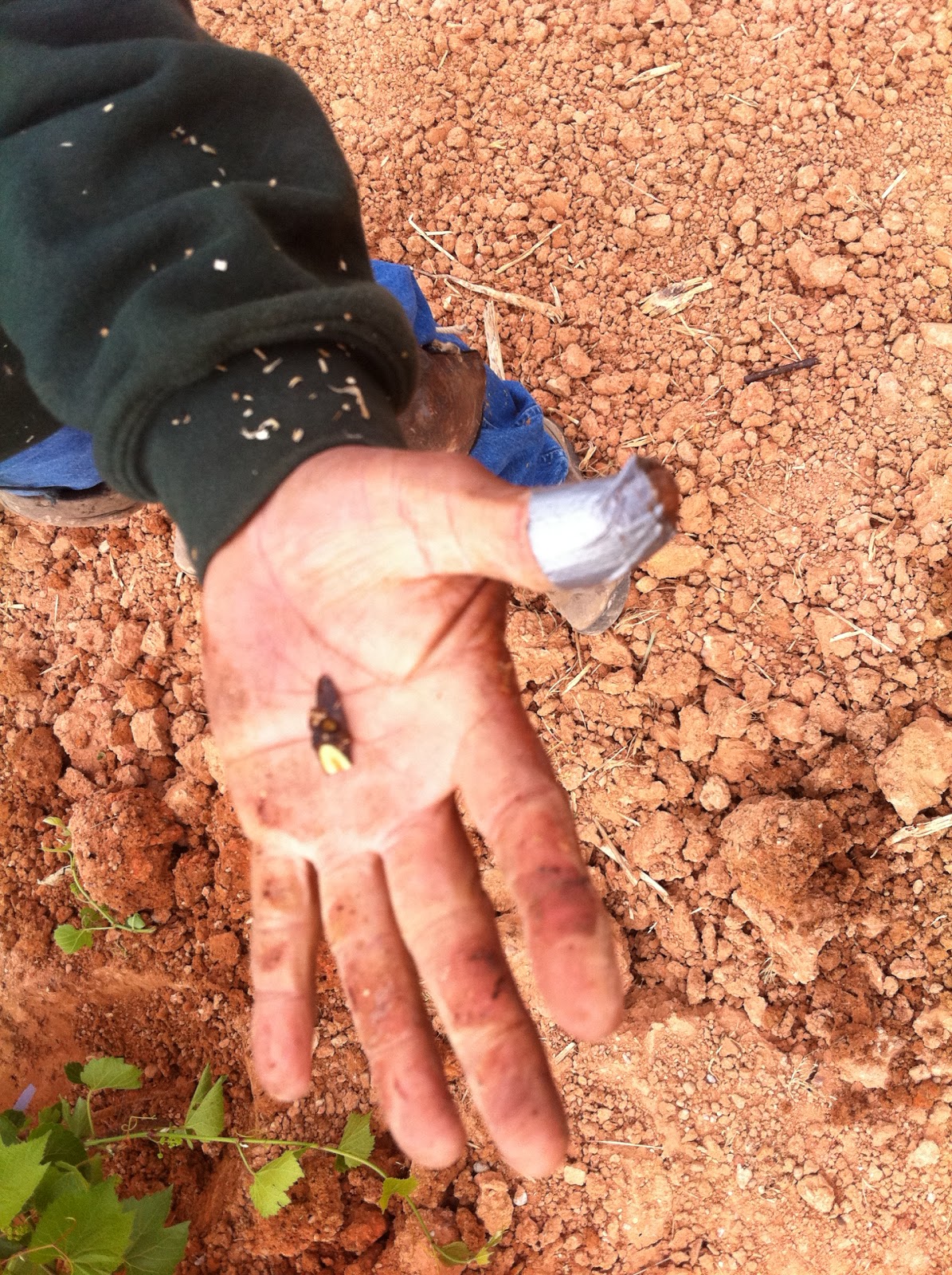
With about 2 feet of growth, the 420A rootstock are ready for grafting.
The grafter skillfully inserts a Pinot noir bud into the rootstock, and ties it in place, as shown in the video and pictures below:

Tuesday, April 24, 2012
April 2012: Spring Growth

During dormancy, the young rootstocks were pruned back to a few inches of growth (above). Currently, the remaining buds have pushed and new shoots have emerged (below).

Thursday, February 2, 2012
February 2012: Glorious Spring Mustard!

The young vines are still dormant but the blooming mustard hints at the arriving Spring...
Tuesday, January 3, 2012

August 2011: Healthy, Growing Vines
By August, the 420A vines are well established.

We had planted a few extra vines that we dug up in order to monitor root growth. We were pleased to see even and vigorous new growth below the ground.


We had planted a few extra vines that we dug up in order to monitor root growth. We were pleased to see even and vigorous new growth below the ground.

Monday, July 25, 2011
July 2011: Mounds Broken Down
After some 11 weeks in the ground, the mounds that originally covered the vines are broken down by hoeing.

Each vine now stands tall and independent.

Each vine now stands tall and independent.
Friday, July 1, 2011


Tuesday, June 14, 2011
June 2011: Vines at One Month


Sunday, May 22, 2011
May 2011: Buds burst under the soil surface
Still under the soil, the tender buds have pushed and have begun to grow. This photo was taken after uncovering a rooting. Look closely to see the pale, young buds


Wednesday, May 11, 2011

May 2011: Planting Rootstocks
The dormant 420A rootstocks for our vineyard come from the nursery in large bins.

Before planting, the roots are trimmed and the vines are soaked in water for several hours.
 A hole is dug for each vine, and each vine is planted by hand.

The vines are then mounded over with several inches of loose soil to protect the fragile buds before the shoots emerge.

Tuesday, May 3, 2011
April 2011: Final Land Prep and Vine Position Layout


Saturday, October 16, 2010
Mengali Plowing Article
A local farm publication (Sonoma Marin Farm News) has written a piece featuring Mengali Plowing. It discusses his work at Dehlinger Winery.
Visit the Dehlinger website for the link to "Sonoma Marin Farm News" to learn more about Mario Mengali and his unique work!
Visit the Dehlinger website for the link to "Sonoma Marin Farm News" to learn more about Mario Mengali and his unique work!
Thursday, October 14, 2010
October 2010
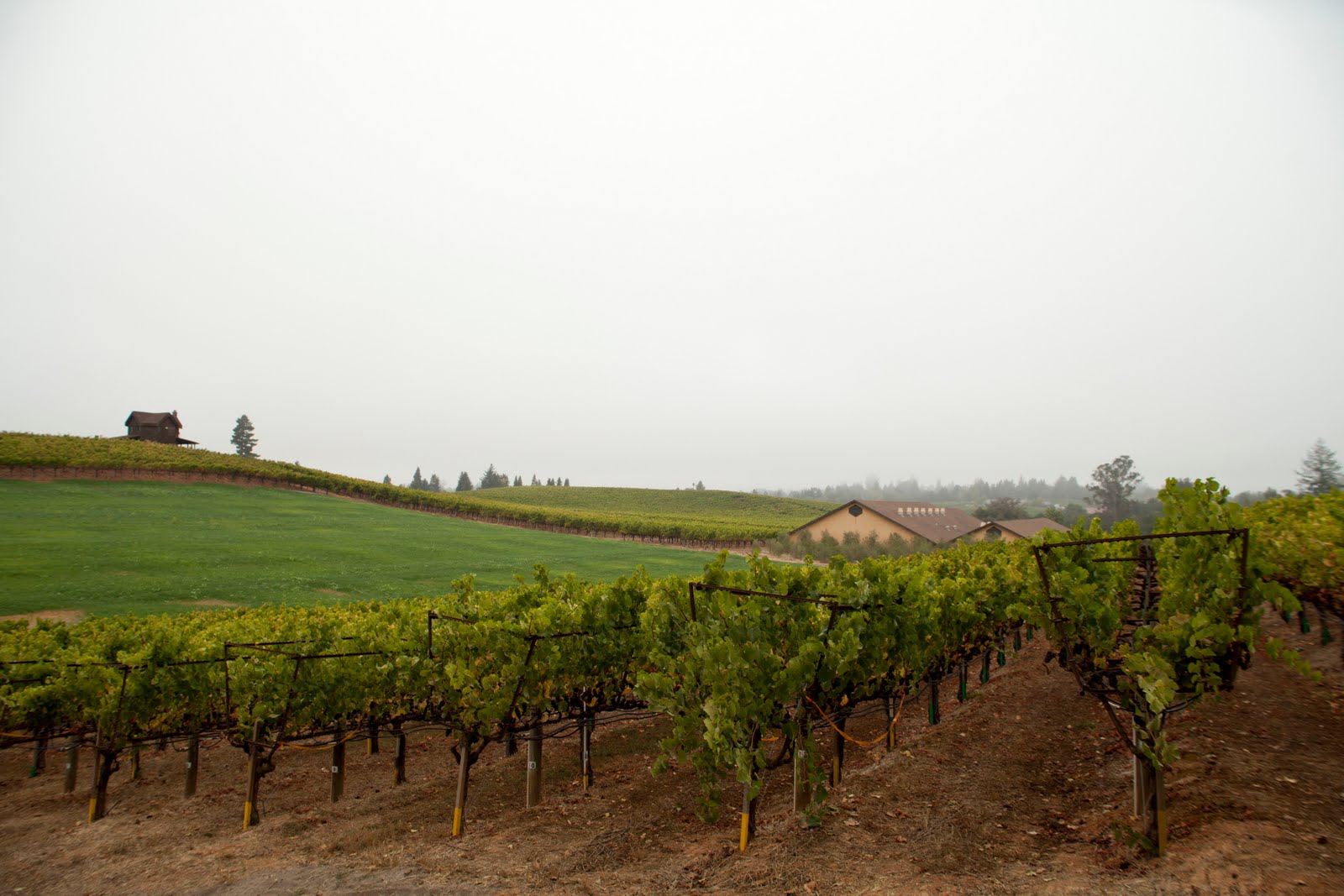 Our cover crop of wheat will help build organic matter and protect against erosion during the winter. This is the second winter of fallow with a cover crop for our redevelopment blocks.
Saturday, September 18, 2010
Summer and Fall 2010
It has been a busy summer for the redevelopment. After the plowing was completed, the surface was smoothed over, and Mike and Jason from Vineyard Layout Services laid out a large grid for our vineyard. Open close examination, the photo below shows the flags they used to mark out the grid:

This flagged layout was used to install highway stakes and end posts on key rows. These stakes became the location of risers for an overhead irrigation system, which we also installed this summer.

The overhead irrigation system will provide protection from frost and heat spikes when the vineyard is mature. This fall, it is being used to establish a cover crop of wheat, which will grow through the straw mulch shown above.

This flagged layout was used to install highway stakes and end posts on key rows. These stakes became the location of risers for an overhead irrigation system, which we also installed this summer.

The overhead irrigation system will provide protection from frost and heat spikes when the vineyard is mature. This fall, it is being used to establish a cover crop of wheat, which will grow through the straw mulch shown above.
Wednesday, July 28, 2010
Spring and Summer 2010
 After mowing the cover crop in the spring, a second set of soil pits were dug to re-examine the soil and conduct further soil testing (Above photo). The results were used to guide a second round of soil amendments, which were spaded into the soil. After allowing the soil to dry out sufficiently, Mario Mengali has returned to deep plow the soil a second time, for further mixing and very thorough root removal from the previous grapes (Below photo).
Wednesday, March 3, 2010
Spring 2010: Planning

Planning for the replant continues. Some blocks will remain fallow for another 2 years, while about 5 acres will be planted next Spring (one year from now). In the meantime, we have chosen our spacing (7 feet by 4 feet), our rootstock (420A), and are planning the trellis and irrigation system.
Friday, October 30, 2009
October 2009: Fall Bounty and Winter Cover Crop


Meanwhile, the summer cover crop was long since mowed, and the winter cover crop of wheat is well established. The fall colors play nicely with the green of the wheat.

Areas with patchier stands of wheat receive an additional seeding, straw, and fibrous netting for erosion control against the coming rains.

Wednesday, August 12, 2009
August 2009: Cover Crop Establishment
We plan to lay the ground fallow for several years before planting the new vineyard. This will help rejuvenate the soil, which was farmed for decades before we planted it in grapes 35 years ago. An important aspect of the fallow period is cover crop establishment. Cover crops play many roles--in our case, it will prevent erosion of soil and introduce organic matter to encourage a healthy soil ecosystem. For the summer, we have selected Sudan Grass, which is abundant in growth and organic matter formation. Additionally, pests such as nematodes do not thrive on Sudan Grass.
We prepared the soil for the Sudan Grass in the following manner:
(Below) We spread 5 tons per acre of compost on the soil to support the cover crop and improve the soil for the future vines.

(Below) We then ripped the soil to incorporate the compost.

(Below) The soil was preparedl for seeds using a 10 foot disk on a John Deere 44 40 Tractor.

(Below) A handful of Sudan Grass seed.

(Below) Marty then used a Brillion seed drill to apply the Sudan Grass at 35 lbs of seed per acre.

(Below) Finally, after sewing the seeds, the Sudan Grass is irrigated to stimulate sprouting.

We prepared the soil for the Sudan Grass in the following manner:
(Below) We spread 5 tons per acre of compost on the soil to support the cover crop and improve the soil for the future vines.

(Below) We then ripped the soil to incorporate the compost.

(Below) The soil was preparedl for seeds using a 10 foot disk on a John Deere 44 40 Tractor.

(Below) A handful of Sudan Grass seed.

(Below) Marty then used a Brillion seed drill to apply the Sudan Grass at 35 lbs of seed per acre.

(Below) Finally, after sewing the seeds, the Sudan Grass is irrigated to stimulate sprouting.


Subscribe to:
Posts (Atom)